
Cat coat colour
Where does hair colour come from, and how is melanin produced?
From the hair follicle to hair colour
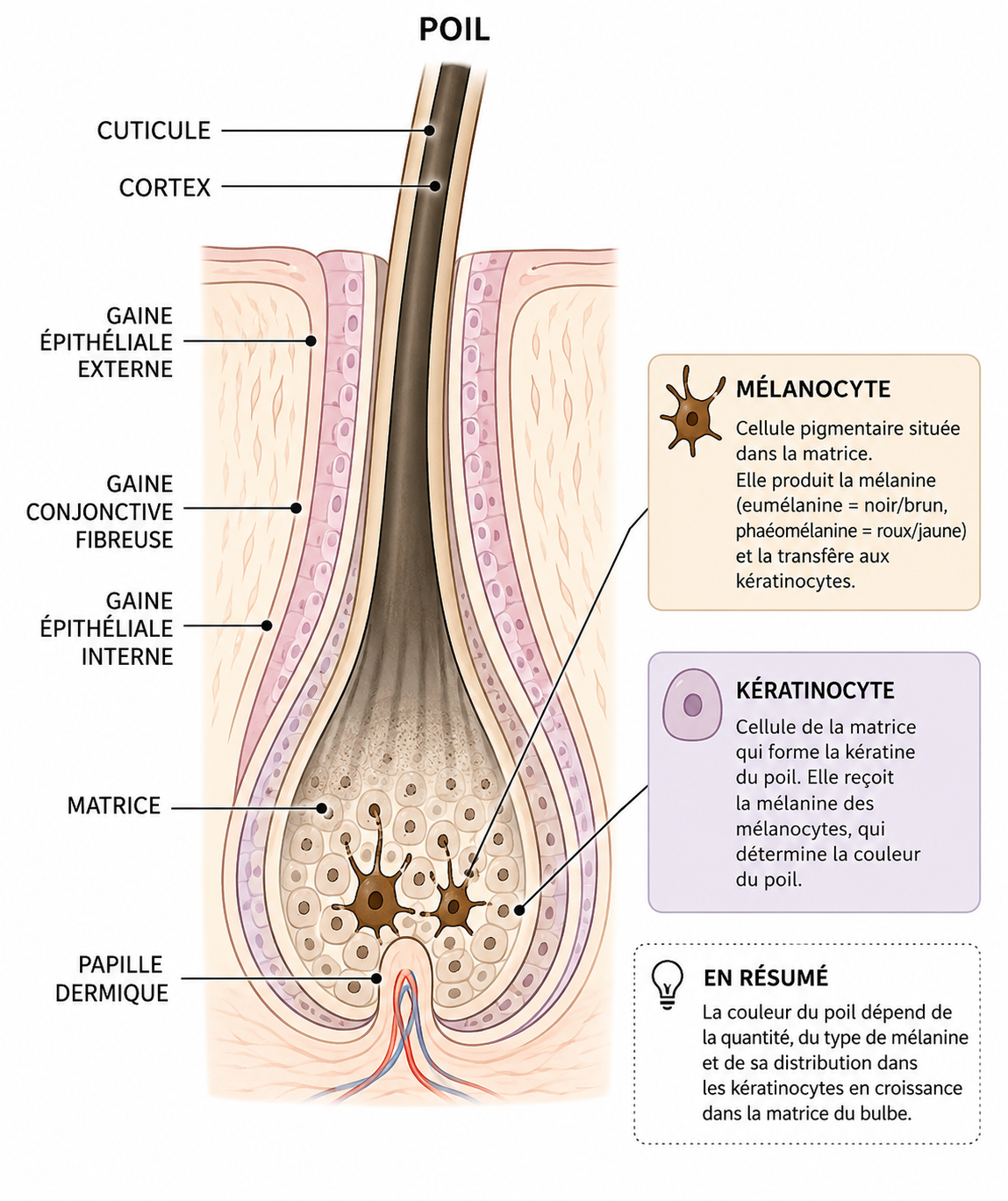
I have tried, from memory, to reconstruct the story of the coat from the fabulous website by Catherine & Alexis Muller-Sautreau, Ailuropus, gone for ever, sniff!
A pigment, melanin, gives colour to every kind of hair, and to the skin as well.
Cats owe their coat colour to two pigments: eumelanin, ranging from brown to black, and phaeomelanin, which is yellow or orange. It all happens at the base of the hair, in the hair follicle.
This is where specialised cells called melanocytes, which synthesise the pigments, are found.
Melanocytes, melanosomes and keratinocytes
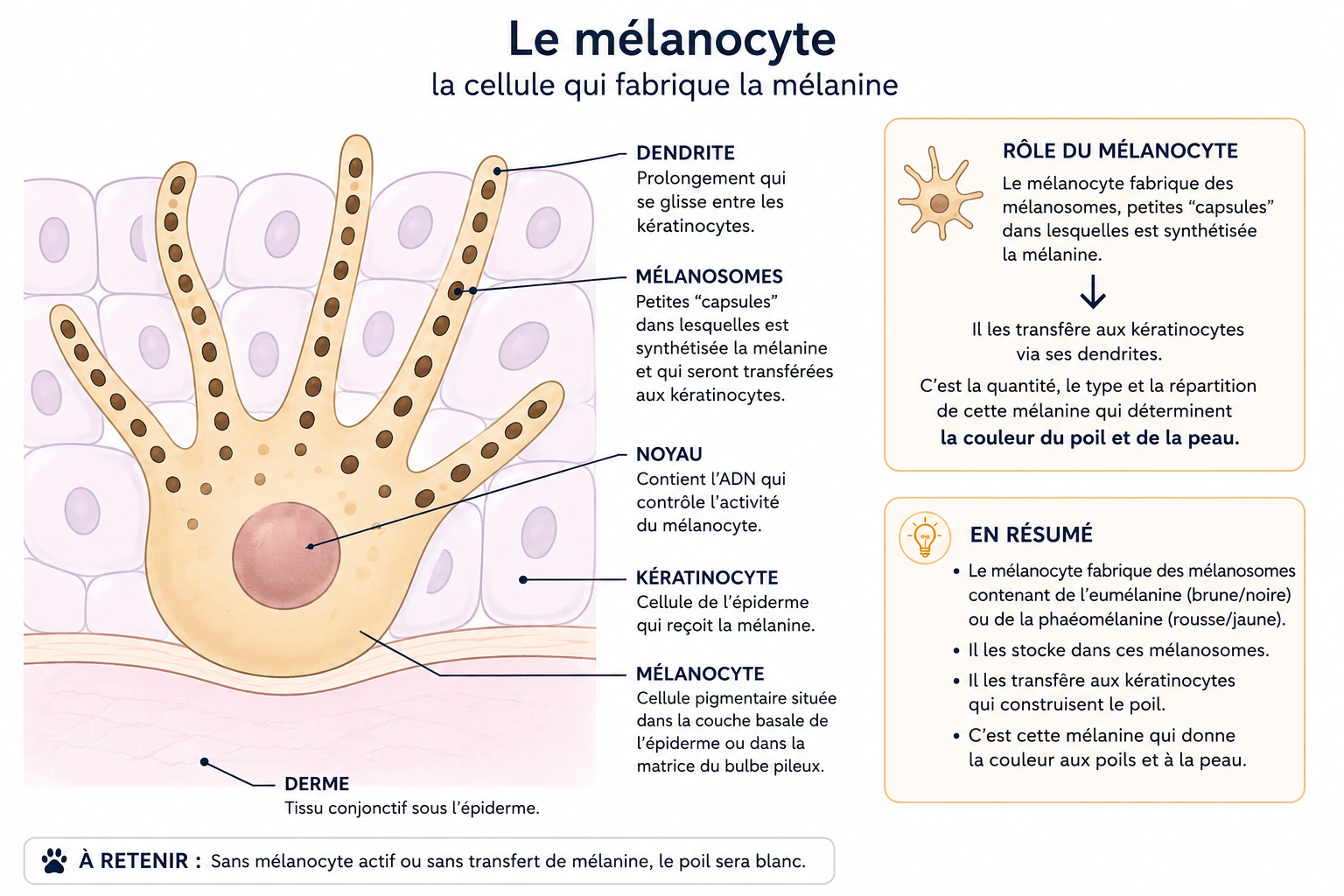
Melanocytes are cells with small, tentacle-like structures called dendrites.
The cell nucleus lies in the middle of the melanocyte. The small dark dots are melanosomes, inside which melanins are synthesised and which, once mature, form the pigment granules.
The dendrites extend into other specialised cells, the keratinocytes.
Keratinocytes produce keratin, a very hard protein that serves as the basic building material for hair. It is found in nails, head hair and body hair, but also in rhinoceros horn and other hooves.
So, let us recap: the melanocyte “makes” melanosomes. Once they are thoroughly “filled” with pigments, transporters carry them from the melanocyte to the keratinocytes.
The melanosomes are attached to the keratin through the dendrites and will give the hair its colour.
Keratin, other ingredients that are not our subject here, and melanosomes, the colour granules: that is the recipe for our cats’ coats.
Variations in colour, as our eyes perceive them and our brain interprets them, are linked to the type and amount of melanin in the hair, as well as to the distribution, size and shape of the granules, which determine how they reflect light...
In short, the whole colour palette is nothing but an optical illusion!
Now you know everything. Breathe. It was terribly simple after all.
Big mistake!
For those who are not tired yet, let us take a closer look at what happens inside melanocytes...
Inside the melanocyte: making melanins
If you have made it this far, I conclude that you want to know everything.
So... melanocytes. Let us start again.
There are only two types of pigment: dark-coloured eumelanin and light yellow or orange phaeomelanin, owing to sulphur-containing components.
But then, you may say, a cat must therefore be black or ginger — except at night, when they are all grey! So where do those rainbows of colour across their backs come from?
Melanin synthesis is an assembly-line job.
After the first shared stages, the melanin synthesis pathways diverge: different intermediates take part in producing eumelanin or phaeomelanin.
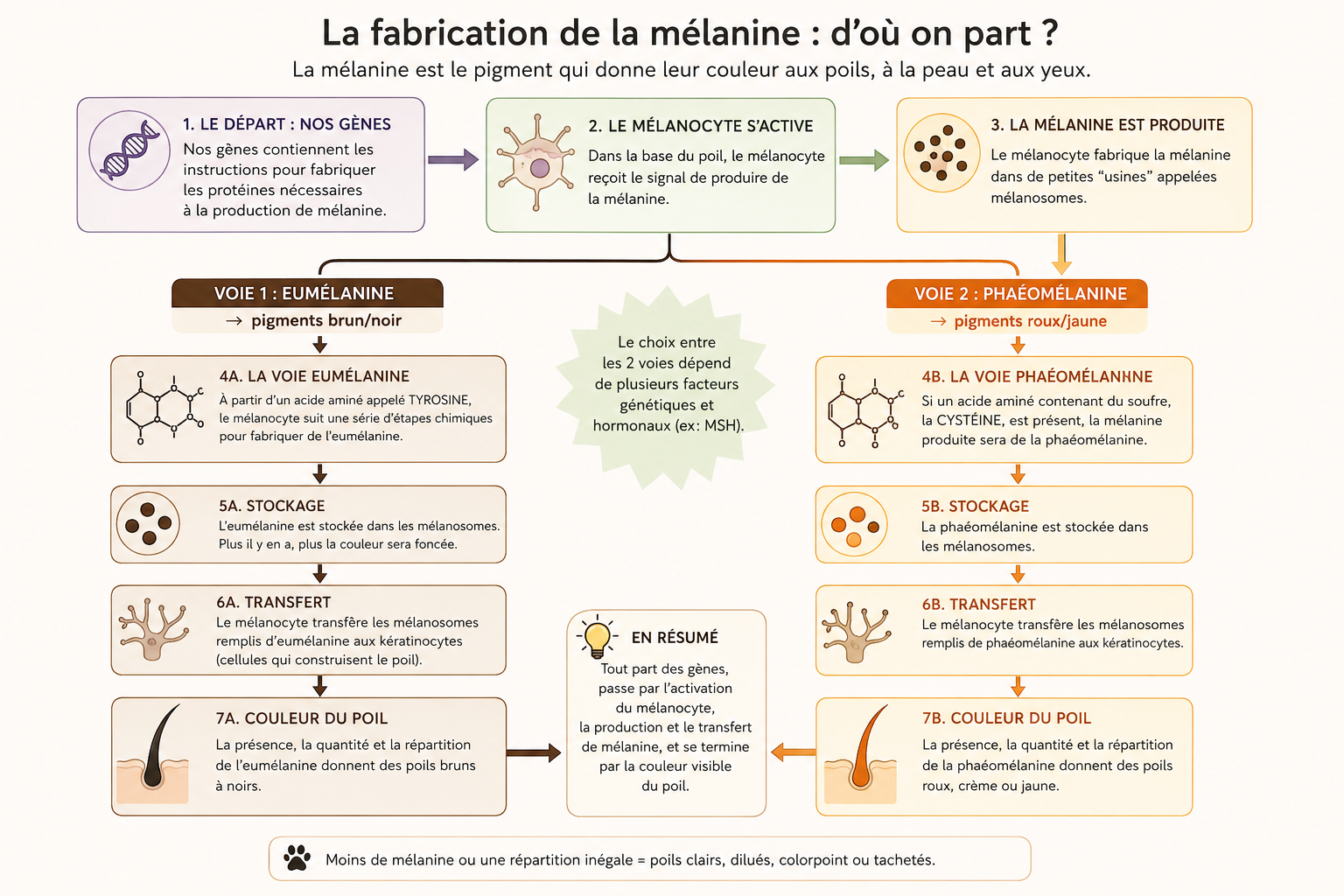
- Do not come complaining — you are the one who clicked!
- Receptors, hormones, enzymes, transporters... they all get to work behind the scenes. Their single mission is to decide which melanin will be deposited in the hair, where, when and how.
For those who want more, the story continues in the next chronicle.