
Allelic series B: the tribulations of eumelanin
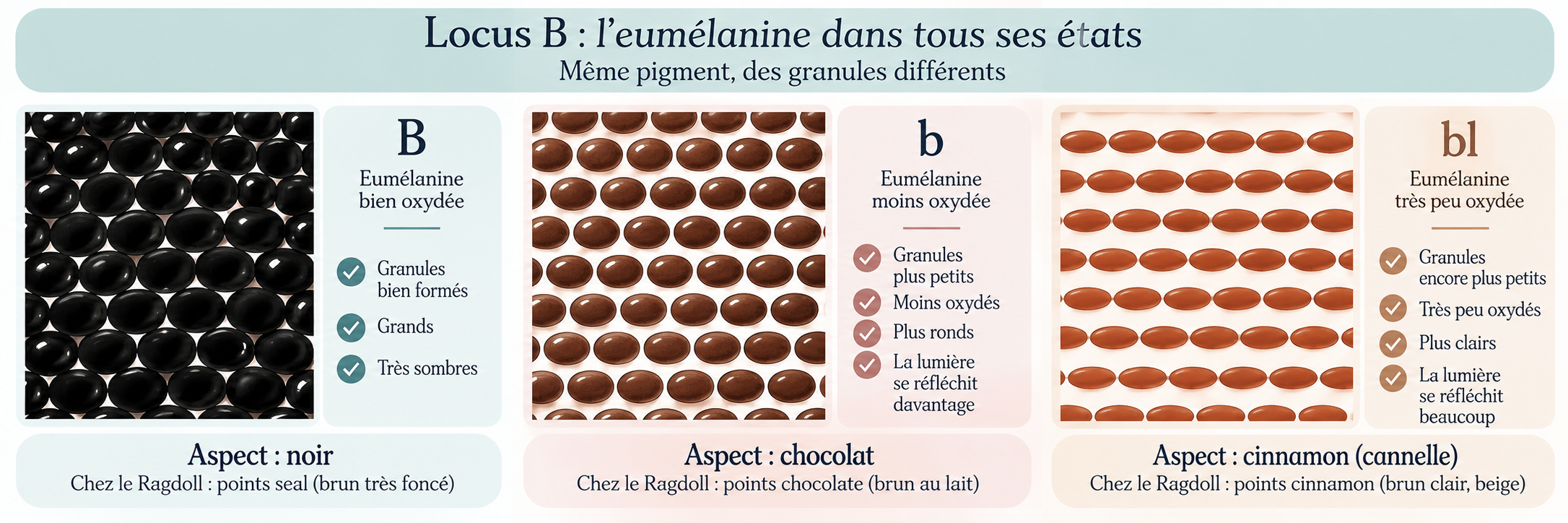
B, b and bl: three versions of the B locus, the same eumelanin and three visible colours.
B, b and bl: the easy version
We have seen that eumelanin is the dark pigment in hair. But even though melanos means “black” in Greek, eumelanin does not necessarily mean a “black coat”. At the B locus, a cat can have three main versions — or alleles: B, b and bl.
B → black
b → chocolate
bl → cinnamon
These alleles follow an order of dominance: B > b > bl. In other words, B dominates the other two, and b dominates bl. Calling an allele “recessive” does not mean that it is weaker: it simply means that its colour is not visible when a dominant allele is present.
A B/B, B/b or B/bl cat will therefore have black eumelanin. In a colourpoint Ragdoll, this colour is seal: the points appear very dark brown. A B/b cat can be seal while carrying chocolate.
For chocolate to be visible, there must be no B: b/b or b/bl produce brown eumelanin. Cinnamon appears in a bl/bl cat.
Seal, chocolate and cinnamon are therefore not three different pigments: they are always eumelanin, but its appearance changes.
Why does the colour change? The role of TYRP1
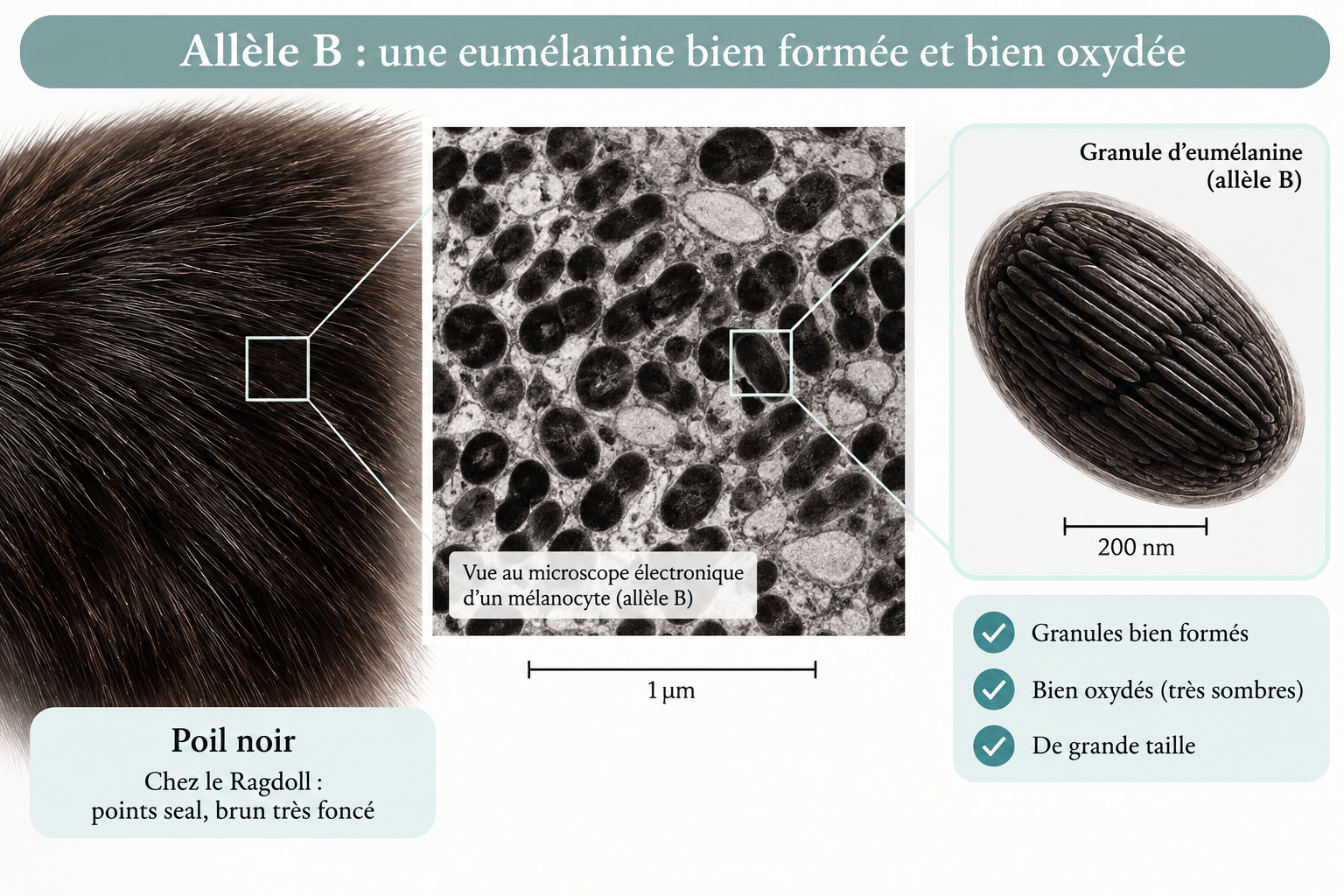
The B allele, as in brown
Let us now look at what actually happens inside the melanocyte. The B locus corresponds to the TYRP1 gene, which allows the TYRP1 protein to be produced. This protein plays an important role in eumelanin synthesis and is involved in the characteristics of pigment granules.
With the wild-type B allele, TYRP1 works normally: the eumelanin pigments are well formed and dark, and the pigment granules are large. Hair loaded with this eumelanin appears black — or seal in a colourpoint Ragdoll.
The b allele and chocolate
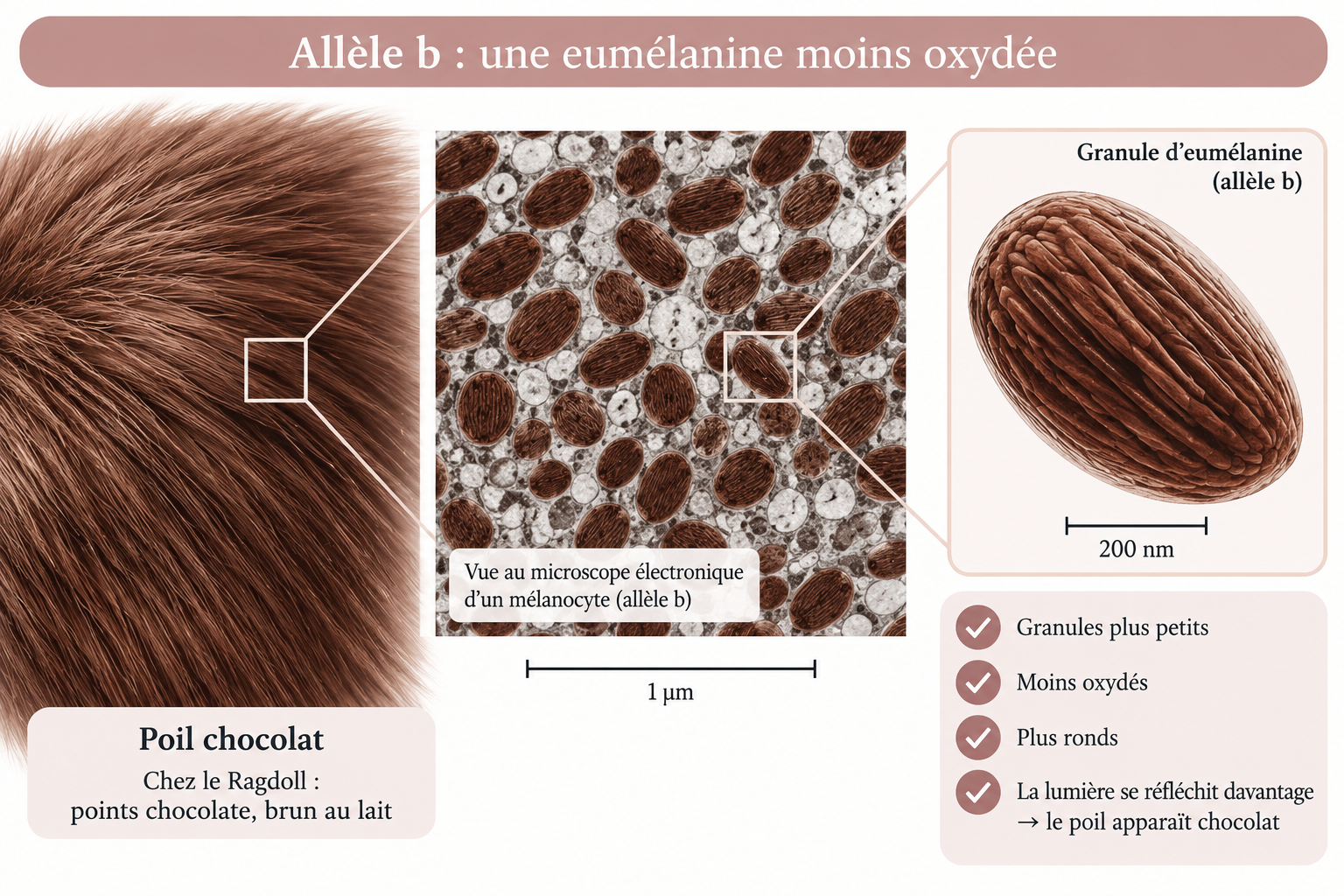
With the b allele, TYRP1 is altered and runs on three legs. The pigments produced are less oxidised and their shape changes: the granules are smaller. Light reflects differently off the hair, which appears brown to us: this is chocolate.
Variants of the TYRP1 gene can therefore be used in genetic testing to identify certain alleles responsible for chocolate and determine whether a cat carries them.
Going further: bl and cinnamon
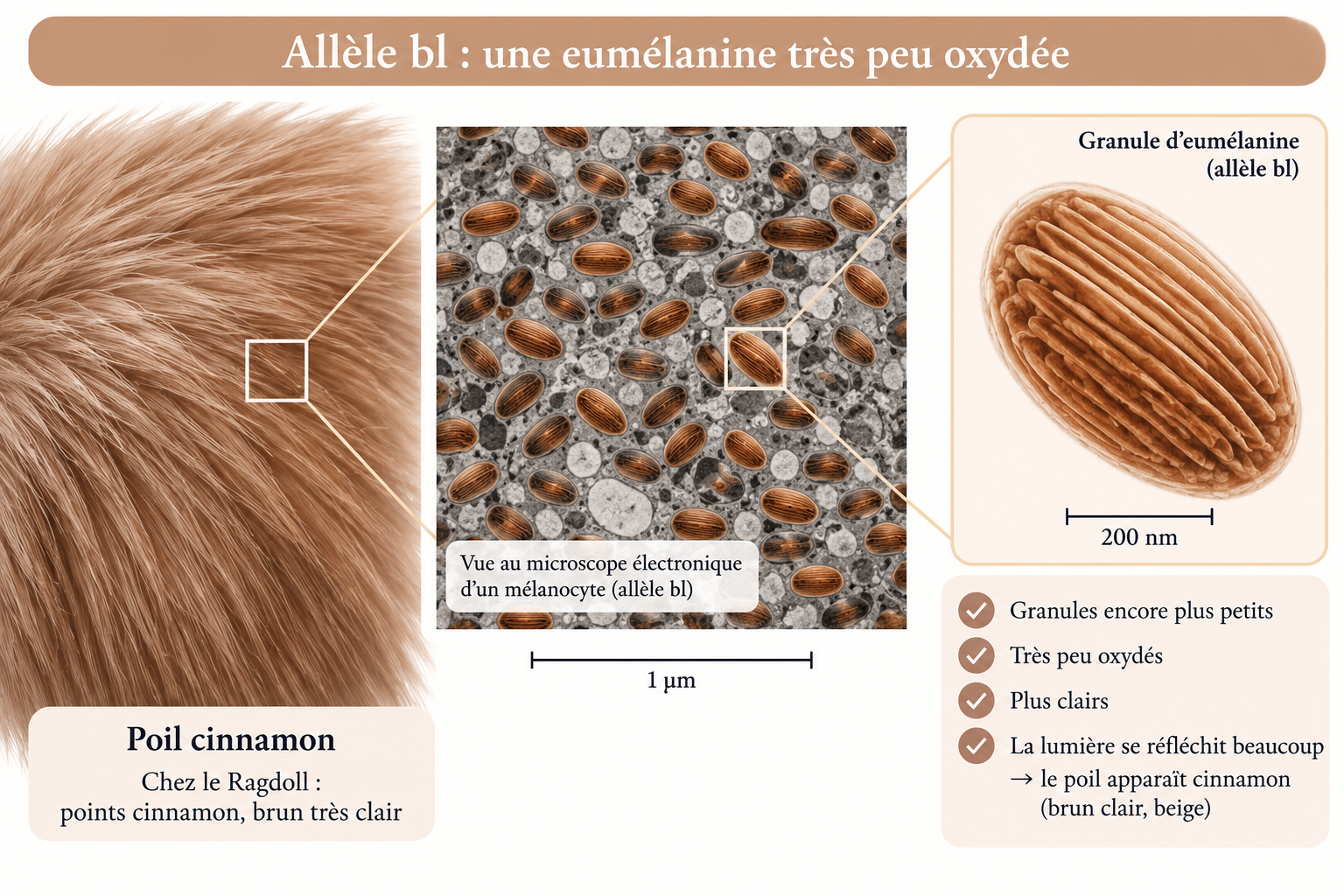
bl — for “brown light” — is the most recessive in the series: it is recessive to both B and b. In a bl/bl cat, the TYRP1 protein produced barely works at all. The eumelanin granules are tiny and less pigmented; the hair appears light brown, cinnamon: this is cinnamon.
Basically, the bl variant slips a STOP in very early in the TYRP1 production line. The cell stops before it has finished: the resulting TYRP1 protein is truncated and virtually unusable.
From melanin to hair
Making the pigment is not enough. It still has to be taken where it needs to go so that it is where it needs to be.
Inside the melanocyte, melanin is produced and stored in small organelles called melanosomes. They do not sit quietly in the centre of the cell: a well-oiled machine carries them towards the melanocyte’s extensions, its dendrites — the little tentacles.
At their tips, the melanosomes are passed to keratinocytes, the cells that make the hair. As the hair forms and grows, it carries with it the pigments that have been distributed to it.
And ginger?
Ginger or cream hair is much less affected, because TYRP1 mainly acts in the eumelanin pathway. Slight variations in phaeomelanin pigments may occur under the effect of b or bl, but they are generally not visible to the eye.
B does not decide whether the cat produces eumelanin: it helps determine what that eumelanin looks like.
So what?
The pigment does not change: once the eumelanin has been made, the die is cast. So?
If only it were that simple, but then...
Then we are going to meet lots of little muscular arms that will have great fun with our lovely granules.